Starting Your Own Business

I strongly believe that every person dreams of his own business at least once in a lifetime. Irrespective of ability and opportunity, this dream makes a home in every heart and mind. Again, it’s a different issue that neither everyone makes happen nor is it a cup of tea for all. I may have a thousand ideas, but an undervalued idea is of no use.  It’s all about making ideas happen. Planning to conquer the world is not easy. Even suppressing the out-bursting ideas within is a difficult situation. We may keep on discussing on this and still, it may fall short of words.

Let me ask you a question…

DO YOU WANT TO START YOUR OWN BUSINESS???

Starting a business takes a lot of effort and commitment. Before you start, it’s important to know what’s involved and if you’re suited to running a business. These questions will help you evaluate yourself and make sure you’re ready.

Do you have the right skills?

Knowledge in your chosen industry is not the only thing that works, running a business requires a wide range of skills.

Are you prepared to sacrifice your lifestyle? 

May it be your leisure or your weekend, all will get affected.

Can you continue through tough times?

Passion and motivation can wear off during hard times. Make sure you’re prepared to keep working even when things are hard. You’ll need to rely on your discipline not to give up.

Do you have access to the money you need?

You need to be in the right financial position to start a business. Starting a business is exciting but also expensive. There will be several up-front costs you will have to consider, as well as ongoing fixed and variable costs involved in running a business.

You may not start making money from your business for some time. It’s important you have enough financial backup. Are you prepared not to have a salary?

Very well said by Kevin O Leary, “Salary is the drug they give to forget your dreams”

You should have enough savings or an alternative income to use while you’re establishing your business.

Are you prepared to seek help?

It’s important that you are comfortable seeking help. Running a business isn’t a simple thing to do and you don’t have to do it alone. Talking to a business adviser or trusted accountant or tax agent can help you solve business problems and connect you to grants and programs.

Are you prepared for the risks?

Unfortunately, you need to be prepared yourself so that your business may not be successful. This might mean that you could lose money, time and investments.

Deciding not to start!! It’s okay if you don’t feel ready to start a business. There are other pathways you can take.

You can:

continue your business idea but as a hobby

think of another idea and assess your new business idea

reassess your situation again in the future – you might be ready then!

Einstein said: “If your head tells you one thing and your heart tells you another before you do anything decide first whether you have a better head or a better heart.”

When you are all set and firmly decided to start a business you need to focus on a few points.

1. Make key decisions

The decisions you make early on can affect many areas of your business, including the licences you need, how much tax you pay, and the volume of paperwork required.

Decide on a business structure

Are you an employee or contractor?

Choose your business location

Each business has different needs for storage, equipment, or just being close to the right customers. Consider what’s important for your business before you decide where you’ll be based.

Choose a business name

There may be more to choosing a business name than you think. Consider whether the name is unique, available to use or exists as a protected trademark before you decide.

2. Plan your business

You’ve analysed your idea and yourself. Next, you can plan your future and see how it all comes together.

Develop your business plan

Required

Planning out your business gives you direction and keeps your business on track. You’ll also need a business plan if you seek finance.

DEVELOP YOUR BUSINESS PLAN

Create your risk management plan. Having a good risk management plan in place will help guide the business decisions you make and reduce the impact of unexpected events on your business.

ASSESS AND MANAGE RISK

Write your marketing plan. Need to tell everyone about your new business? A marketing plan can help you find and reach your customers and work out what makes your business different.

DEVELOP YOUR MARKETING PLAN

Develop your export strategy. If you’re going to sell your goods or services overseas, make sure you plan. An export plan can help you discover new markets and the best way your business can operate in them.

3. Help your business

Find resources to help you with your business, from general business advice to financial assistance and support for your mental health and well-being. Find help for your business. Need help? Never hesitate to talk to a business adviser, accountant or solicitor for advice. Find resources to help with your business finances. Financial advisers, accountants or bookkeepers can help you get your finances on the right track.

RESOURCES TO HELP WITH YOUR BUSINESS FINANCES

Get support for your mental health and well-being. Being a business owner can be stressful. Find services, resources and information to look after your own and your employees’ mental health and well-being. MENTAL HEALTH AND WELL-BEING SUPPORT FOR BUSINESS

4. Register your business

To make it official, you’ll need to register. This makes sure your business gets taxed at the right rate, avoids penalties and protects your brand and ideas. Australian business number (ABN). An Australian business number (ABN) is unique to your business. Customers, suppliers and the Australian Taxation Office (ATO) use this number to help identify your business. An ABN is free to register.

REGISTER FOR AN AUSTRALIAN BUSINESS NUMBER (ABN)

Business name-A business name helps your customers identify your business from others. If your business name is different to your own name, you’ll need to register it.

REGISTER YOUR BUSINESS NAME. Tax registrations for your business. Not all taxes will apply to your business. It depends on the type of business you’re starting, your activities and turnover. It’s best to work out what taxes you need to register before you start your business.

TAX REGISTRATION FOR YOUR BUSINESS

Licences and permits-From zoning laws to a food licence, the licences and permits you need will vary. They often depend on the location of your business and the industry you’re in.

REGISTER LICENCES AND PERMITS

Company-A company is a legal entity in its own right. If you’ve decided a company is the right business structure for your business, you’ll need to register.

REGISTER A COMPANY

Trademark-Protect your business name and brand from being used by others by registering it as a trademark.

5. Prepare your finances

It’s essential to take charge of your business finances and know how to manage your cash flow. It could make or break your business. If you need help, consider speaking to a financial adviser. Learn how to organise your finances. Apart from having a business bank account, you’ll need to know how to organise your finances. This includes managing cash flow, budgets, payments and invoices. Consider using a bookkeeping or finance system to help you.

Understand your finance options. Learn about the different finance options and how they relate to your business situation.

OPTIONS FOR SEEKING FINANCE

Develop a pricing strategy. There’s a lot that goes into setting a price for your goods and services. Use the calculations and strategies available to help set your prices so you don’t sell yourself short.

DEVELOP A PRICING STRATEGY

Learn about invoicing and payments. An invoice allows your customers to pay you for your goods and services and for you to provide them with a record of their purchase. Work out the type of invoice you will need and what to include in your invoices.

6. Know the law

Finding out your business isn’t entirely above board can cost you time and money. Start off strong by setting up and protecting your business legally. Consider speaking to a legal professional to help you along the way. Learn the legal essentials for business

Understand fair trading laws. Fair trading and consumer laws protect you, your business and your customers. Find out how you can make sure you protect your rights and those of your customers.

Understand contracts-When you agree to do a job for another person or business, you’re likely to be entering into a contract. Find out what makes a contract fair and what laws there are to protect you.

7. Protect your business

You invest too much time and money in your business to lose it. Protect your investment by planning. As a business owner, you are responsible for managing health and safety for you and your employees in the workplace.

Understand business insurance-Insurance can help protect your business and your employees against the worst of situations. Find out which types of insurance are essential for your business and those you may want to consider. Prepare your business for an emergency. Planning ahead for what to do in an emergency can strengthen your business and help it recover quicker. To get started, see how you can protect your business assets and establish your emergency procedures.

Protect your Intellectual Property. Have a unique business idea and don’t want it getting into the hands of the competition? See how Intellectual Property (IP) can help protect your ideas here and overseas.

Protect your business from cyber threats- Whether your business is mostly online, or you just use an online system to store your customer information, make sure you have measures in place to keep your business and data safe.

8. Prepare for tax

Getting on top of your taxes now can make things easier in the long run. It can help you avoid penalties and make sure your business is taxed at the correct rate. A good record-keeping system can help you get on top of your records. It can also help you track your progress and seek finance if required.

Understand taxation for your business

Understanding tax requirements help make sure your business is taxed correctly and avoids penalties. Get an overview of record keeping, registering for taxes and your options for paying tax.

Learn how to lodge and pay for the tax. How you lodge your tax will depend on your business structure. Find out what you need to lodge and if a Business Activity Statement (BAS) is needed.

9. Set up operations

Setting up your business operations properly will save you trouble in the long run, and give you more time to focus on running your business. Learn about hiring employees.

Manage your suppliers. Are you selling products and need a supplier? See what you should consider when looking for a quality supplier and where you can search for them.

Consider going online

Taking your business online can provide new opportunities and benefits to your business. Look at ways you can set up your business’s online presence, from simply having a social media presence to using e-commerce to sell your products and services to online customers.

10. Market your business

Promote your business and brand to your target audience to grow your customer base. Working out your business’s market position will help you to build your business brand, find your target audience and focus on your customers’ needs.

Communicate with customers.

Providing good customer service is not just for when a customer buys from you. Find out what customer service skills you’ll need to create customer satisfaction and loyalty.

Set up a business website. Register your web address as early as possible.

Establish your brand

Your business’s brand can help you connect better with your customers and help them differentiate you from your competition.

Plan your social media presence

A well-planned and managed social media presence can help you market your business and connect with your customers.

Businesses are the backbone of an economy. They provide products and services that can be purchased by individuals and other companies. Businesses range in size from small to large and operate in many different industries. Business structures also vary from sole partnerships to major corporations that provide shareholder equity to their owners.

When starting a business, do your research and develop a business plan. This allows you to raise the money you need to start your operation.


How Does An Accountant Add Value To Your Small Business?

The contemporary business environment is increasingly dynamic, with new accounting needs that businesses must contend with for sustainable growth. Failure to keep up with local and international accounting needs poses serious risks like derailed relations with business partners, local, government, and international litigations for compliance-related charges, or loss of vital client accounting information. Therefore, having an accountant adds value to your business in the following ways;

Avoid Accounting Compliance Charges and Penalties

Accountants are well-versed in accounting practices that every business institution should uphold. As such, an accountant can guide your business towards ethical accounting practices to help you avoid compliance charges from applicable laws. Additionally, by helping your business observe accounting ethics, an accountant will enable you to avoid any associated accounting penalties, thereby minimizing your business expenses.

Minimizing your Tax Liabilities

Accountants know prevailing taxation conditions and can take advantage of certain opportunities to minimize their tax bills. For instance, an accountant would take advantage of tax exemptions and other short-lived related incentives, thereby reducing your tax liabilities. Furthermore, an accountant will inform you of overpayments that might have resulted from shifts in taxation clauses that you would have otherwise ignored and continued with previous taxation clauses in meeting your tax obligations.

Conceptualize your Financial Structure for Effective Decision-Making

An accountant helps draws a clear financial structure for your business, allowing you to determine how best to fund your business operations. For instance, determining your debt-to-equity ratio and liquidity ratios will provide you with a clear image of what elements of your financial structure you can adjust to realize business objectives without compromising your financial position. Thus, accountants help the continued survivability of your business under myriad business conditions.

Adds Credibility to Your Operations

Having a certified accountant helping with your accounting needs raises the authenticity of your business operations. It puts your clients at ease knowing that any accounting-related information the company uses is factual, up-to-date, and reliable. Furthermore, it boosts your confidence in your operations, knowing that all accounting information gives a true image of the event they represent, and you can make necessary decisions without second-guessing yourself.

Help Increase Profitability

An accountant will help you determine your business expenses and draw a succinct cash flow for your business operations. This information will help you prioritize your expenses and scrap off unnecessary costs while investing more in key expenses to propel your profitability to the next level.

Update your Tax Structure

Your business tax structure evolves with your business growth with smaller businesses and individual tax schemes gradually growing to meet requirements for the corporate tax system. An accountant helps you subscribe to an appropriate tax structure and meet your tax obligations as the business grows without facing litigations, tax penalties, or other crippling taxation compliance penalties.

Make Credible Projection on Business Operations

Making operations projections like demand forecasting and cash flow projections is crucial for small businesses, which must determine their current business position to develop effective strategies to propel them to where they would like to be. Having an accountant is critical towards achieving this goal as they collect and logically present historical business transactions and financial positions to enable your business to develop appropriate strategies for managing risks. Furthermore, these projections help in proactive risk identification and formulation of risk management strategies for seamless business operations.

Conclusion

The current business environment makes accountants indispensable as they add value at every level of business operations facilitating sustainable business growth. Therefore, finding a qualified and competent accountant is imperative to help you realize all the benefits of an accountant in your small business.

Adopting Tax Planning Strategies For A Long-Term Investments

Tax rates and laws continuously evolve as local and federal governments forge the best economic conditions to meet their goals. Thus, having an effective tax planning strategy is crucial in meeting individual or business objectives without clashing with the government’s tax policies. Smart tax planning aims to reduce your tax obligations while operating within the law. Some smart tax planning strategies for a good long-term investment include;

Invest in Tax-Efficient Investments

Tax-efficient investments offer reduced taxation or even zero taxation on gains from those investments. Tax-conscious investors maintain a portfolio of tax-efficient investments like municipal bonds, long-term capital gains, tax-managed mutual funds, and retirement accounts, among others, to minimize the tax expenses on gains from these investments. For instance, gains from municipal bonds are usually tax-free, and those from securities like stocks and options are subject to taxation. Therefore, in times of economic uncertainties, one could opt for risk-free municipal bonds with lower taxes than highly volatile stocks subject to taxation.

Hold investments for longer periods

Investment taxations vary with the investment period. Short-term investments, i.e., those held within 12 months or lower, are taxed under the ordinary income tax rates. However, investments held for more than 12 months are usually at a lower tax scheme, i.e., a maximum of 23.25 per cent maximum and 30 per cent for individuals and companies, respectively, which varies according to long-term capital gains policies by the Australian Taxation Office. Therefore, holding an appreciating asset, say stock or option contracts, for more than a year, would be more tax effective. For example, the returns on an investment held for a year when taxed under the ordinary income tax rates, then the tax rates increase with an increase in the returns. However, investments held for more than one year have a maximum tax rate of 23.25 per cent. Additionally, the Australia Taxation Office provides a 50% discount on capital gains or losses for Australian residents, leaving you with more in your pocket.

Consider Tax Loss Harvesting

Tax loss harvesting is a tax-efficient technique that allows you to lower your taxable income from an investment by offsetting its gains with the losses of another asset. This technique allows an investor not to incur losses and taxes from the winning investment and rather lowers its taxable income as it offsets the loss from the other asset. Moreover, if your investment losses exceed your gains, you can use this technique to offset up to USD 3000 of taxable income annually. For instance, say you bought a certain volume of Asset A at AUD 10,000 in 2015. In 2022, the asset market value will be AUD 97,105.20. You also invested in asset B in 2016 at AUD 10,000; in 2022, its market value is at -AUD 7,568.38. From Asset A, you have gains of AUD 87,105.2 and a net loss from Asset B of – AUD 2,431.62. You can decide to hold asset B through to 2023, hoping that it might appreciate and sell asset A, incurring capital gains taxes on the AUD 87,105.2. This will imply that you will incur capital gains taxes on asset B upon selling it in 2023. However, with loss harvesting, you would sell both assets simultaneously and have a net gain of AUD 84,673.58. Therefore, the total taxation on your gains will be lower as your taxable gain for the year has reduced from AUD 87,105.2 to AUD 84,673.58.

Conclusion

Every investor’s dream is to maximize their investment returns while complying with government tax policies. Therefore, investors should employ smart tax planning strategies like tax loss harvesting and long-term investment and consider tax-efficient investments to achieve these ends.

Work From Home Running Expenses Deduction

The ATO has issued new draft guidelines replacing the existing fixed rate method.

Key Points

· Replaces existing 52c fixed rate method

· Applicable from 1st of July 2022

· In place for expiring COVID-19 short cut 80c method

· New rate is 67c per hour

· Includes all expenses like Electricity, Gas, home office cleaning, and mobile and internet costs

Eligibility

· Work from home to fulfil your employment needs or to run your business

· Incurring additional running expenses

· Keep and retain records of time spent

Pros

· Better rate than the previous fixed rate

· Providing long-term certainty after the Covid-19 rate has expired

Cons

· Needs detailed documentation for hours spent for the entire duration (previously only a sample record was required)

· Includes mobile and internet costs as well, so cannot claim separately for them

· Does not consider the recent high inflationary scenario where energy costs have soared more than 50%

· 16.25% lesser than the COVID-19 rate

FBT Rule Changes For Electric Vehicles

Electric Vehicles, especially below a certain range, would be more affordable for businesses, due to a new change in law for FBT. The Treasury Laws Amendment (2022 Measures No 2) Bill has passed the Parliament and introduces electric car discounts as an FBT exemption.

Key Points

Car benefit will be an exempt benefit for a year of tax, if:

· The car is zero or low emissions vehicle and includes electric or hybrids until 1 April 2025

· Initial retail sale price of the car was below the luxury car threshold for fuel-efficient vehicles i.e. $84,916 currently, and

· The car is first held and used on or after 1 July 2022

Example Scenario

For a customer with

· Gross income of $95,000

· Using a 36-month novated lease

· To buy a 2022 Tesla Model Y

· EMI would reduce from $1,863 p.m. to $1,364

· Total savings of $29,451 over the lease period

For the employer, in the same example of Tesla valued at $64,000, the company would save $12,500 due to the change in FBT.

However, car fringe benefits that are exempt from FBT will continue to be included in the employees’ individual fringe benefits amount for the purposes of determining the employee’s reportable fringe benefits amount.

Quick Tips For Small Business CGT Concessions

The small business capital gains tax (CGT) concessions are a set of tax provisions that allow eligible small business owners to pay less tax on capital gains they make on the sale of certain business assets. To be eligible for these concessions, a business must meet certain criteria, including having an aggregated annual turnover of less than $10 million and satisfying the “maximum net asset value test.” The concessions can provide significant tax savings for small business owners, but it is important to carefully consider the rules and seek professional advice to ensure that the concessions are applied correctly. Some tips for navigating the small business CGT concessions include keeping good records, obtaining a valuation of the assets being sold, and seeking professional tax advice. 

  • Affiliates

Remember your spouse’s and children’s birthdays…and that they are no longer automatically your affiliates.

Determining whether a person is an “affiliate” is important in several contexts related to small business capital gains tax (CGT) concessions, including when applying the:

  • Maximum net asset value test
  • Small business test
  • Active asset test

Since 1 July 2007, an individual or company is considered an affiliate if they act (or could reasonably be expected to act) in accordance with your directions or wishes, or in concert with you, in relation to the affairs of their business. It’s important to note that an individual or company can only be an affiliate if they are carrying on a business. Trusts and superannuation funds, however, cannot be affiliates. A person is more likely to be considered an affiliate if there is a close family relationship between them and a lack of formal agreement dictating how they should act. However, an individual or company is not considered an affiliate simply because of their business relationship. In The Taxpayer v FCT, the Administrative Appeals Tribunal rejected the argument that one of the directors of the taxpayer (and the son of the controller) was a small business affiliate of the company. The tribunal found that the son’s actions could be explained by their position as a director and employee of the taxpayer.

  • Connected Entities

Consider whether the beneficiaries can sense a pattern.

Here are the key points to consider when determining whether an entity is connected with another entity in the context of small business CGT concessions:

  1. Connection depends on “control” – whether one entity controls the other, or both entities are controlled by a common third entity.
  2. A “control percentage” is generally 40% or more (subject to the Commissioner’s discretion when the percentage is between 40% and 50%).
  3. In the case of a discretionary trust, control can be established through influence over the trustee or through the “pattern of distributions” rule.
  4. Control can only be established in the year after a sufficient distribution (of 40% or more) is made – not in the year of the distribution.
  5. Once a beneficiary has received sufficient distribution, they will be connected to the trust for the next four years.
  6. If a discretionary trust does not make a distribution in an income year, the trustee may nominate up to four beneficiaries as controllers of the trust.
  7. A special rule exists to ensure that exempt entities or deductible gift recipients do not control the trust under the pattern of distributions control rule. (Contd.)
Small Business CGT Concession
  • Control

As mentioned above, an entity with significant influence over a trustee can be found to have control over the discretionary trust. An entity controls a discretionary trust (and is therefore connected to it), if the trustee of the trust acts, or could reasonably be expected to act, in accordance with the directions or wishes of that entity and/or their affiliates. This definition shares similarities with but is broader than, the definition of affiliate discussed in tip 1.

Some factors that may be relevant in determining whether an entity has influence over the trustee of a discretionary trust include:

  • The way in which the trustee has acted in the past
  • The relationship between the entity and the trustee
  • The amount of any property or services transferred to the trust by the entity
  • Any arrangement or understanding between the entities and a person or persons who have benefited under the trust in the past

Previously, the Australian Taxation Office (ATO) took the view that the appointor of a discretionary trust (with the right to appoint and remove trustees) did not automatically control the trust under this particular test. However, this is no longer the case. The application of this control rule was considered in the case of Gutteridge v FCT, in which the question was whether the daughter of Mr Gutteridge controlled the trust under the influence test. While the daughter was the sole director and shareholder of the trustee, the evidence showed that she was simply a figurehead who rubber-stamped decisions made by her father. As a result, the Administrative Appeals Tribunal (AAT) held that the father, not the daughter, controlled the trust. This case illustrates that substance should be given precedence over form – even to the extent that a sole director and shareholder of a trustee cannot be said to automatically exert significant influence over that trustee. (Contd.)


  • Significant Individuals

Trying for a better class of shareholders can lead to significant problems.

There are numerous aspects of the small business capital gains tax (CGT) concessions where it is important to have a “significant individual” and/or a “CGT concession stakeholder.” In general, a significant individual in a company or trust is someone who has a “small business participation percentage” of 20% or more. A CGT concession stakeholder is a significant individual or the spouse of a significant individual who has a small business participation percentage greater than zero. Therefore, understanding the concept of small business participation percentage is crucial. This percentage is the lowest percentage of the individual’s direct and indirect:

  • Voting power in the company
  • Entitlement to any dividend that the company may pay
  • Entitlement to any distribution of capital that the company may make

If a company has different classes of shares and the discretion to pay a dividend to one class of shareholder to the exclusion of another, no shareholder can be said to have an entitlement to any dividend that the company may pay. This means that the company will not have a significant individual or a CGT concession stakeholder. While it may be beneficial to stream dividends to certain shareholders (e.g. those on lower income levels), creating different classes of shares should only be done with caution if it is anticipated that the small business CGT concessions will be accessed. At a minimum, the benefits should be weighed against the potential costs.

Small Business CGT Concession
  • 15-Year Exemption

Know when it is time to go.

Here are the key points to consider when determining whether an individual qualifies for the small business 15-year exemption:

  • The individual must be 55 years or older when the CGT event occurs
  • The CGT event must happen in relation to their retirement
  • Retirement must involve at a minimum a significant reduction in the number of hours the individual works or a significant change in the nature of their activities
  • If the individual agrees to stay on in the business for a transitional period after a sale, they should be careful to ensure that this does not jeopardize their access to the 15-year exemption. If the transitional period is less than six months, access to the exemption should not be at risk.

Why Losses Are Shown In The Assets Side Of Balance Sheet?

In a business, losses are not the end of the road, but rather an opportunity to learn and improve. They are the result of an action or initiative taken in an effort to achieve success or risk taken in anticipation of creating something better or bigger. Losses are a record of what might not work in a situation or what should be avoided in the future and are a valuable tool for analysis.

In the modern technology-driven startup world, losses are stepping stones to building gigantic ideas of success in the future. Just like Thomas A. Edison, who suffered 1,200 attempts of failure before inventing the light bulb, businesses must be willing to take risks and learn from their mistakes in order to achieve success.

Similarly, in our personal lives, personal losses, adversities, challenges, setbacks and bottlenecks are all opportunities to create something new, to find an alternate way, and to come across something that was not previously tried. Napoleon Hill mentions in his 10th principle of success, in the Master Key that, with a positive mental attitude and an urge to learn more every time, we can turn every such incident into an asset. The bigger the incident, loss or damage, the bigger the opportunity to create something better. It is our determination to succeed, passion to realize our dreams and perseverance to get up every time we fall down that turns a loss into an asset, something we can benefit from and draw inspiration from throughout our lives.

Businesses are considered as going concerns of enterprise, mechanisms to earn profits and systems to earn positive cash flow year after year. A loss is temporary, a momentary lapse and a learning opportunity for the next phase of action in the journey to success. It’s important to remember that losses are not failures, but rather opportunities to improve and grow.

Vacancy Fee For Foreign Owners

As a foreign owner of a residential property in Australia, it’s important to be aware of the vacancy fee that may apply to your property. The vacancy fee is an annual fee that is applied to properties that are not occupied or available for rent for at least 183 days (6 months) in a 12-month period.

This fee was introduced in December 2017 as part of the Australian Government’s comprehensive housing affordability plan. The aim of this fee is to act as a financial incentive for foreign owners to make their properties available for rent, thereby increasing the available housing in Australia.

It’s important to note that the vacancy fee is 1% of the taxable value of the property, and is due annually on the anniversary of the day the property was acquired. It’s also important to be aware that there are exemptions and concessions available for certain properties, such as those that are occupied or available for rent for at least 183 days in a 12-month period, properties that are under development, or properties that are used for specific purposes such as affordable housing or student accommodation.

If you’re a foreign owner of a residential property in Australia, it’s important to check whether you may be liable for the vacancy fee and ensure that you comply with your obligations to pay the fee. Failure to pay the vacancy fee may result in fines and penalties, and in certain cases, the property may be sold to recover any unpaid fees.

For more information about the vacancy fee for foreign owners of residential property in Australia, you may consult with us for more details and how to comply with the law.

In conclusion, the vacancy fee is an annual fee that is applied to properties that are not occupied or available for rent for at least 183 days in a 12-month period. The aim of this fee is to act as a financial incentive for foreign owners to make their properties available for rent, thereby increasing the available housing in Australia. As a foreign owner, it’s important to be aware of the vacancy fee and to check whether you may be liable for the fee.

Who needs to lodge a vacancy fee return?

As a foreign owner of a residential property in Australia, it’s important to be aware of the vacancy fee return that may apply to your property. The vacancy fee return is a form that must be lodged by foreign owners of residential dwellings who:

  • Made a foreign investment application for residential property after 7:30 pm AEST on 9 May 2017
  • Purchased under a New Dwelling Exemption Certificate that a developer applied for after 7:30 pm AEST on 9 May 2017.

It’s also important to note that the vacancy fee may also apply where a foreign person failed to submit a foreign investment application but purchased a residential property before 9 May 2017.

It’s worth mentioning that foreign owners of vacant land do not have to lodge a vacancy fee return until a dwelling has been constructed on the land. In the case of multiple dwellings being constructed on the land, a vacancy fee return must be lodged for each new dwelling constructed.

It’s important to note that you must lodge a return even when the dwelling has been occupied or made available for rent.

If the dwelling is owned by 2 or more people as joint tenants, you only need to lodge one return. However, if you own a share of a dwelling as a tenant in common, you each must lodge a vacancy fee return. If you are not sure whether you are a joint tenant or a tenant in common, please refer to the definitions on the Foreign Investment Review Board (FIRB) site.

In some cases, a vacancy fee return will not be required to be lodged, for example:

  • The dwelling is sold or otherwise legally transferred (including in the event of the death of the owner)
  • You are no longer a foreign person.

In conclusion, the vacancy fee return is a form that must be lodged by foreign owners of residential property in Australia, who have made a foreign investment application after 9 May 2017, or purchased under a New Dwelling Exemption Certificate that a developer applied for after 7:30 pm AEST on 9 May 2017. Foreign owners of vacant land do not have to lodge a vacancy fee return until a dwelling has been constructed on the land. If the dwelling is owned by 2 or more people as joint tenants, you only need to lodge one return. However, if you own a share of a dwelling as a tenant in common, you each must lodge a vacancy fee return. For more details, you may consult our office for a Vacancy Fee form and payment instructions.


When is a dwelling residentially occupied?

When it comes to determining whether a dwelling is considered residentially occupied, there are a few key factors to consider. A dwelling is considered residentially occupied if, for at least 183 days in a vacancy year, any of the following circumstances are met:

  • The owner or a relative of the owner genuinely occupied the dwelling as a residence.
  • The dwelling was genuinely occupied as a residence subject to lease or license for a minimum term of 30 days.
  • The dwelling was made genuinely available as a residence on the rental market with minimum terms of 30 days.

It’s important to note that residential occupancy of at least 183 days does not need to be one continuous block of time. Residential occupancy can be made up of multiple continuous periods of at least 30 days throughout the vacancy year.

However, it’s worth noting that dwellings made available for short-term leases of fewer than 30 days (including via web-based stay sites) are not considered residentially occupied and would be liable for a vacancy fee.

To be considered genuinely available for occupation as a residence, the dwelling must be:

  • Made available on the rental market.
  • Advertised publicly.
  • Available at a market rent.

It’s important to mention that if COVID-19 (coronavirus) has affected how your property was residentially occupied and you need help completing your vacancy fee return, you may consult our office.

To prove a dwelling was residentially occupied during a vacancy year, you may be required to provide supporting evidence, such as lease agreements, rental receipts, and other documentation.

In conclusion, a dwelling is considered residentially occupied if, for at least 183 days in a vacancy year, any of the following circumstances are met: the owner or a relative of the owner genuinely occupied the dwelling as a residence, the dwelling was genuinely occupied as a residence subject to lease or license for minimum terms of 30 days, the dwelling was made genuinely available as a residence on the rental market (with minimum terms of 30 days). However, dwellings made available for short-term lease of fewer than 30 days (including via web-based stay sites) are not considered residentially occupied and would be liable for a vacancy fee. To prove a dwelling was residentially occupied during a vacancy year, you may be required to provide supporting evidence.


10 Easy Steps You Can Turn Customers Credit Policy Into Success

A customer credit policy is an important aspect of any business, as it helps to manage the financial risk associated with extending credit to customers. By setting clear guidelines for credit approval, credit limits, and collections, a credit policy can help to ensure that a business is able to maintain a healthy cash flow and avoid financial losses due to unpaid debts. Additionally, a credit policy can help to build trust and loyalty among customers by providing them with a clear and fair process for obtaining credit. Overall, a well-designed customer credit policy is essential for any business looking to grow and succeed in today’s competitive marketplace.

Photo by Anastasia Shuraeva for happy customers
Photo by Anastasia Shuraeva

Below are some easy steps to create a successful customer credit policy –

  1. All customers must complete a credit application before an account is established. The application should include financial information such as credit references and financial statements.
  2. Credit limits are established for each customer based on the information provided in the credit application and any additional credit references or financial information obtained.
  3. Customers would be required to pay for goods or services within the agreed-upon credit terms. These terms will be clearly stated on all invoices.
  4. A monthly statement of account is sent to all customers with an outstanding balance.
  5. A past-due notice will be sent to customers who have not paid within the agreed-upon credit terms.
  6. A collection process will be established for customers who do not pay within the agreed-upon credit terms. This process will include phone calls, email reminders, and letters.
  7. If a customer’s account becomes seriously delinquent, legal action may be taken to collect the debt.
  8. Credit will be reviewed on a regular basis, and the credit limit may be reduced or credit may be revoked if a customer’s financial situation changes.
  9. Any changes to the credit terms must be approved by the management before they are communicated to the customer.
  10. All credit information should be kept confidential and should be used only for the purpose of credit management.

However, when overdue debts become too high, it can signal that a business’s current customer credit policy is not effectively managing the financial risk associated with extending credit to customers. High levels of overdue debt can put a strain on a company’s cash flow and increase the risk of financial losses. Therefore, in order to protect the financial health of the business, it may be necessary to make changes to the customer credit policy to address the issue of overdue debt.

At Amaze Accounting, we provide you with a complete outsourcing service to manage your Accounts Receivable and Accounts Payable process effectively. We follow a customised process based on your business scenario to manage your vendor and customer relationships while ensuring that your financials are on balance. We help you generate personalised reports to identify key areas for your focus and how you can calibrate your approach to minimise your working capital needs. If you’d like to discuss more on this please book a free consultation right away.

Here’re some of the ways, you can alter your credit policy to make it effective and get back on track –

  1. Increase credit review frequency: More frequent credit reviews can help identify customers with deteriorating financial situations before their debts become too large.
  2. Tighten credit terms: Reducing credit terms for all customers or for specific high-risk customers can help to reduce the amount of overdue debt.
  3. Increase collection efforts: Increasing the frequency and intensity of collection efforts can help to speed up the payment of overdue debts.
  4. Implement a stricter credit application process: The credit application process can be made more rigorous, to ensure that only customers who are likely to pay on time are approved for credit.
  5. Implement deposit or advance payment requirements: Requiring a deposit or advance payment from customers can help to reduce the amount of overdue debt.
  6. Increase the use of credit guarantees and collateral: Asking for a personal guarantee or collateral can help to reduce the risk of overdue debts.
  7. Implement a dunning process: Dunning process is a series of reminders and warning letters sent to the customers to pay their overdue amount.
  8. Limit the amount of credit offered to high-risk customers: Limiting the amount of credit offered to high-risk customers can help to reduce the amount of overdue debt.
  9. Seek external help: if the level of overdue debts is too high, it may be necessary to seek external help such as hiring a collection agency.

It’s worth noting that any changes to the credit policy should be implemented with caution, as they can have a significant impact on the business relationship with its customers. It would be best to consult with legal and financial experts before making any significant changes

Top 10 Challenges As A Tradie To Manage Your Finance

As a tradesperson, managing your finances can be a daunting task. From keeping accurate records to staying compliant with tax laws, there are many challenges that can arise when managing your accounting and bookkeeping. In this blog, we will outline some of the key challenges faced by tradies and how to overcome them.

1. Keeping accurate records of expenses and income

One of the most important aspects of managing your finances as a tradie is keeping accurate records of your expenses and income. This will help you keep track of your cash flow and ensure that you are able to pay bills and taxes on time.

2. Keeping up to date with tax laws and regulations

Staying compliant with tax laws and regulations is an ongoing challenge for tradies. Tax laws and regulations change frequently, so it’s important to stay informed about the latest changes and how they affect your business.

3. Managing accounts payable and receivable

Managing accounts payable and receivable can be time-consuming and challenging, but it’s essential for the success of your business. Keeping track of your accounts payable and receivable will help you maintain cash flow and ensure that you are paid on time.

4. Maintaining invoicing and receipt records

Keeping accurate records of invoices and receipts is important for maintaining your financial records and ensuring that you are able to claim all the tax deductions you are entitled to.

5. Time management for bookkeeping tasks

Bookkeeping tasks can be time-consuming, especially if you are running a busy trade business. It’s important to allocate enough time to bookkeeping and make it a priority.

6. Staying organised with paperwork

Staying organised with paperwork is key to managing your finances efficiently. From invoices to receipts, make sure you have a system in place for keeping track of your financial records.

7. Keeping track of depreciation and assets

Keeping track of the depreciation of your assets and maintaining accurate records of your assets is important for tax purposes and can help you plan for the future.

8. Maintaining cash flow

Maintaining a positive cash flow is essential for the success of your business. Keeping accurate records and managing your accounts payable and receivable will help you maintain cash flow and ensure that you are able to pay bills and taxes on time.

9. Secure storage of financial records

Securing your financial records is essential for protecting your business and ensuring that your confidential information is protected. Make sure you have a secure system in place for storing your financial records.

10. Finding reliable software or outsourcing options

There are many software options available to help you manage your finances, but finding the right one can be challenging. Alternatively, you may want to consider outsourcing your bookkeeping tasks to a professional bookkeeper.

In conclusion, managing your finances as a tradesperson can be a challenging task, but with the right tools and strategies in place, it can be made easier. From keeping accurate records to staying compliant with tax laws, make sure you take the time to manage your finances effectively.

ASIC Cancels Registration of 374 SMSF Auditors

What You Need to Know 

The Australian Securities and Investments Commission (ASIC) has recently cancelled the registration of 374 auditors of self-managed superannuation funds (SMSFs) who failed to lodge their annual statements. This is a crucial step taken by ASIC to maintain trust and confidence in the SMSF sector, which holds more than $865 billion in assets in over 600,000 funds.

As per ASIC Commissioner Danielle Press, “SMSF auditors play a fundamental role in promoting confidence and instilling trust in the SMSF sector. It is crucial that SMSF auditors comply with their regulatory obligations. ASIC will continue to take action where they do not meet these obligations.”

Recently, ASIC communicated with over 1,400 SMSF auditors regarding their outstanding annual statements. Most of these auditors subsequently lodged their statements, but for those who didn’t, a notice of cancellation was sent on 23 January 2023. Based on data from the Australian Taxation Office, the cancelled SMSF auditors had not performed a significant number of SMSF audits in the past two to three years.

It is important for SMSF auditors to complete and lodge their annual statements on time to avoid cancellation of their registration. They should also keep their contact details updated. The lodgement of annual statements and updates to contact details can be done via the ASIC Regulatory Portal.

SMSF trustees and members can check the registration status of their auditor by searching ASIC’s SMSF Auditor Register. This will ensure that their investments are protected and they can have peace of mind knowing that their auditor is compliant with all regulatory obligations.

In conclusion, ASIC’s recent cancellation of the registration of 374 SMSF auditors is a step towards maintaining trust and confidence in the SMSF sector. It is crucial for SMSF auditors to comply with their regulatory obligations to avoid cancellation of their registration and for SMSF trustees and members to check the registration status of their auditor.

Fringe Benefit Tax

The 2023 FBT year ends on 31 March 2023, so it’s a good time to start thinking about your FBT obligations. You’ll need to work out if you have an FBT liability for fringe benefits you’ve provided to your employees or their associates between 1 April 2022 and 31 March 2023. If you have an FBT liability or paid FBT instalments on your activity statements, you need to lodge an FBT return and pay the amount due by 22 May. This date applies as the statutory due date of 21 May falls on a weekend this year. However, if you use a registered tax agent like us to lodge on your behalf, the due date would be the 25th of June.

If you don’t need to lodge an FBT return and you’re registered for FBT, you should still the ATO know by the date your return would have been due. Remember to keep all records relating to the fringe benefits you’ve provided, including how you calculated the taxable value of benefits.

What is Fringe Benefits Tax (FBT)?

FBT is a tax imposed on employers for benefits provided to employees, such as a company car or low-interest loans. It is calculated based on the taxable value of these benefits.

Do You Have an FBT Liability?

To determine if you have an FBT liability, you’ll need to calculate the taxable value of any benefits provided to your employees or their associates between April 1st, 2022, and March 31st, 2023.

Filing Your FBT Return and Payment

If you have an FBT liability, make sure to file an FBT return and pay the owed amount by May 22nd. And if you use a Registered Tax Agent, then you get an extended due date till the 25th of June. Even if you don’t have to file a return, let the Australian Taxation Office (ATO) know by the due date.

Keeping Records

It’s essential to keep records of all benefits provided and their taxable value for easy reference. The ATO provides a wealth of information and resources on FBT, including guidelines on calculating the taxable value of benefits, on its website.

Make sure to determine your FBT liability, file your return and pay what’s owed by the due date, and keep all relevant records. Get all the information you need on FBT at the ATO website.

PAYG Instalment Variations

The ATO is encouraging accountants to educate clients about varying PAYG instalments – this can potentially assist cash flow.

To recap, PAYG (pay-as-you-go) instalments allow business taxpayers to make regular prepayments towards the tax on their business and investment income. This is in contrast to salary and wage earners who already make payments by having tax withheld from their income each time they are paid.

Business taxpayers, including individuals who are contractors for PAYG withholding purposes, will automatically be entered into the PAYG instalments system if they earn over the entry threshold in business and investment income in their latest lodged tax return. These thresholds currently stand at:

  • Individuals (including sole traders and trusts) – your instalment income from your latest tax return was $4,000 or more, and the tax payable on your latest notice of assessment was $1,000 or more, and you have estimated (notional) tax of $500 or more.
  • Companies and super funds – have instalment income from their latest tax return of $2 million or more, or have estimated (notional) tax of $ 500 or more, or are the head company of a consolidated group.

If your or your business’s financial situation has changed, your expected tax liability may also change. This means your current PAYG instalments may add up to more, or less, than your tax liability at the end of the financial year.

The good news is that you can vary your instalments so the amount you pay is closer to your expected tax for the year.

If you pay PAYG instalments using the instalment dollar amount provided by the ATO (option 1 on your Activity Statement),

you may want to vary if there has been a significant change in your instalment income this year.

If you calculate your PAYG instalments using the instalment rate (option 2 on your activity statement):

You do not need to vary simply because your income has changed – the payment you calculate will go up and down in line with your income.

  • You would usually only vary if the taxable proportion of your income has changed – for example, if your income has fallen significantly but your deductions for running costs have stayed the same.
  • There are however dangers in varying. If you vary your instalments downwards and you underestimate your eventual income for the year, you could be left with a substantial tax bill when you lodge your tax return at the end of the year. Also, when the ATO receives your tax return, they compare your actual instalments to the total tax payable on your instalment income for the income year. If your varied instalments are less than 85% of your total tax payable, you may have to pay a general interest charge on the difference, in addition to paying the shortfall. Depending on the circumstances there may also be penalties.
  • If you are not sure, it is best to not vary your instalments. Any overpaid instalments will be refunded to you after you lodge your tax return.
  • If you feel your current year’s business or investment income is likely to be more or less than the dollar amount of your PAYG instalments you are paying, feel free to chat with us about varying your instalments.

Crystalising Capital Losses

On the superannuation front, we now have two major reports assessing how super accounts fared in the 2022 calendar year. SuperRatings issued its average balanced return recently and found it was minus 4.8%. Late last year, ChantWest undertook a similar exercise – reporting a figure of minus 4.6%. There have been four negative years since 2000. In 2002, there was an identical return of minus 4.8%, and in the horror 2008 GFC year, the average super fund fell 20%.

Regarding property, CoreLogic’s capital city index declined 8.8% from its May 2022 peak to December, down 7.1% in calendar year terms, being the worst calendar year results in 42 years.

It’s important however to be mindful that these losses are merely paper losses. That is, these losses are only realised, and locked in, if:

  • in the case of property or shares, you sell the asset, or
  • in the case of superannuation, by selling assets or withdrawing super when investment balances are down.

If you retain the asset, you may be able to ride things out, and hopefully, the market bounces back. For example, the average return for the average balanced fund since 2000 is 6.1% (a period that takes into account the aforementioned 20% downturn during the GFC) – that’s $30,500 a year for every $500,000 you can get into super. Things should improve!

If you determine that an asset has little potential for future growth and decide to sell and happen to make a capital loss – there is a silver lining from a tax standpoint! You can deduct capital losses from your capital gains to reduce CGT liability. Capital losses must be used at the first opportunity. If you have any capital losses in the current year or unused capital losses from previous years, you must use these losses to reduce any capital gains in the current year and use the earliest losses first.

Of course, tax is not the only consideration when weighing up whether to retain or dispose of a CGT asset. Talk to your advisors before selling.

FBT and Car Logbooks

With the end of the FBT year approaching, are your car logbooks in order?

The operating cost method is used by many employers to calculate their car FBT liability.

This method is particularly effective where the business use of the vehicle is high. Keeping a logbook is essential to use the operating cost method.

Employees need to prepare a logbook for any vehicle that you provide them with where there is an element of private use. The logbook period is for 12 weeks, which must be representative of typical usage. For example, a period where an employee is taking a block of annual leave is not representative.

Where employees share a vehicle during a year, each employee will need to prepare a logbook to

substantiate their respective business use percentage.

Logbooks are valid for five FBT years (including the year the logbook is prepared), provided there is

no significant change in the vehicle’s business use. Once the five-year period expires, a new logbook will need to be kept if you wish to continue using the operating cost method. Therefore, if a logbook was last prepared in 2017/18, a new logbook is required for this FBT year (2022/23). As noted, a new logbook will need to be prepared where there is a significant change in the business use of a vehicle. Indeed, it is in an employer’s interest for a new logbook to be prepared where the business use of the vehicle increases, as this will result in a decreased FBT liability. With just weeks to go in the FBT year, if a new logbook is required to be kept, but has not yet been…don’t panic! The 12-week period can overlap two FBT years provided it includes at least part of the relevant year.

The logbook must contain:

  • when the logbook period begins and ends
  • the odometer readings at the start and end of the logbook period
  • the total number of kilometres travelled during the logbook period
  • the number of kilometres travelled for each journey. If you make two or more journeys in a row on the same day, you can record them as a single journey
  • the business use percentage for the logbook period
  • the make, model, engine capacity and registration number of the car.

For each journey, record the:

  • reason for the journey (such as a description of the

business reason or whether it was for private use). Note that a generic description of a journey, such as “business use”, is not adequate

  • start and end date of the journey
  • odometer readings at the start and end of the journey, and kilometres travelled.

These entries should be made contemporaneously, as soon as possible after each trip.

It’s a common misconception among employers with commercial vehicles such as dual-cab utes that they are automatically exempt from FBT and therefore there is no requirement to maintain a logbook. This is generally only the case where private use is negligible.

Super Teething Issues

Last year 9,700 individuals applied for compassionate release of supper for dental treatment expenses, and 82% were approved. Out of those approved, 9% were for a dependent child’s dental treatment, which could include braces. What is the pathway for access?

While normally superannuation must be preserved for retirement, there are limited exceptions. One of these is compassionate grounds. An individual must apply to the ATO for a determination that an amount of the person’s preserved benefits or restricted non-preserved benefits in their fund are released on compassionate grounds due to the individual lacking the financial capacity:

1. to pay for medical treatment (defined as life-threatening illnesses or to alleviate acute or chronic pain or mental disturbance or medical transport for the person or a dependant)

2. to enable payments to prevent foreclosure by a mortgagee or the exercise of an express or statutory power of sale over the family home

3. to pay for home and vehicle modifications to accommodate the special needs of a severely disabled person or dependant

4. to pay for expenses associated with the person’s palliative care, death, funeral or burial, or

5. to meet expenses in other cases where the release is consistent with items (a) to (e).

Where one of these conditions is met, the benefit must be released as a single lump sum not exceeding the amount that is determined by the ATO to be reasonably required, based on the nature of the hardship and the person’s

financial capacity. The ATO must provide a copy of its written determination to both the individual applicant and the trustee of their superannuation fund.

Turning back to dental treatment, point (a) is the relevant release condition. The applicant will need to demonstrate that they are suffering acute or chronic pain such that they require dental treatment to alleviate that pain, and that they are lacking the financial capacity to pay for that treatment. From an evidentiary perspective, an applicant would almost certainly need to furnish the ATO with correspondence from a dentist that speaks to the above, and also evidence of their financial position.

The ‘acute or chronic pain’ requirement means that cosmetic procedures such as teeth whitening, dental veneers, dental bonding, dental implants, dental bridges, dental crowns/tooth caps, orthodontics, and white tooth fillings are all unlikely to qualify.

There is no lifetime limit on the number of applications that you can make. For example, if you had three children who all required braces, then potentially you could tap into your super for each child’s procedure. Before making an application, individuals should consider:

alternative funding sources, such as loans the impact on your retirement savings, noting the compounding nature of superannuation investments. Each time you dip into your super, you’re killing off the power of compound interest. Instead of braces costing $7,000 or more, compounding interest means that it may be several multiples of this by the time you retire.

New Work-From-Home Record-Keeping Requirements

Are you one of the five million Australians who claim work-from-home deductions? If so, stricter record-keeping rules may now apply.

For this financial year and moving forward, there are now only two methods to calculate your work-from-home claim:

1. Revised fixed rate method (with new rules applying)

2. Actual costs method (unchanged).

The actual costs method has never been all that popular because you need to keep records of every expense incurred and depreciating asset purchased, as well as evidence to show the work-related use of the expenses and depreciation assets. By way of example, to claim electricity expenses, the ATO suggests that you need to find out the cost per unit of power used, the average amount of units used per hour (power consumption per kilowatt hour for each appliance), and the number of hours the appliance was used forwork-related purposes.

For this reason, the fixed rate method has been preferred (or in recent years the COVID shortcut method where you could simply claim 80 cents for each hour worked from home. Note however that the COVID method is no longer available).

The fixed-rate method has now been revised. The revised fixed-rate method increases your claim from 52 cents to 67 cents per hour. However, this rate now includes internet, phone, stationery, and computer consumables. Therefore, you can’t claim

these expenses separately in addition to your home office fixed-rate deduction. Cleaning expenses

and depreciation on office furniture are no longer included in the fixed rate. Therefore, you can now claim these expenses separately.

  • The record-keeping requirements under the revised fixed rate method are now more onerous, also. You now need to keep a record of actual hours working from home. The ATO will accept a record in any form, but it suggests either:

timesheets, rosters, logs of time spent accessing systems, time-tracking apps, or a diary. The ATO will no longer accept estimates or a four-week representative diary.

  • This new, strict record-keeping requirement applies from 1 March 2023. For the period before it (1 July 2022 to 28 February 2023) the ATO will accept a four-week representative diary.
  • Further, under the revised fixed rate method, you will now also need to provide at least one document for each type of expense to demonstrate that you actually incurred that expense. For example, if you receive electricity

bills quarterly, you will need to keep one of those quarterly bills as a record to represent that year’s electricity expenses.

This information has been prepared without taking into account your objectives, financial solutions, or needs. Because of this, you should, before acting on this information, consider its appropriateness, having regard to your objectives, financial situation, or needs. 


Legislating The Purpose Of Superannuation

On February 2023, Treasury released a consultation paper on legislating the purpose of superannuation. This is an idea that has been around since 2016 where the former coalition government contemplated doing the same thing. 

The government says that legislating an objective of superannuation will provide stability and confidence to policymakers, regulators, industry, and the community and that future changes to superannuation policy should be aligned with the purpose of the superannuation system. It will also ensure members and funds have a shared understanding of the purpose of superannuation throughout both the accumulation and retirement phases.

The consultation paper puts forward the following proposed objective, seeking feedback on it:

The objective of superannuation is to preserve savings to deliver income for

a dignified retirement, alongside government support, in an equitable and sustainable way.

To be clear, the purpose of legislating such an objective is to guide future policymakers – any changes they make in the superannuation space should align with the legislated, agreed objective.

For example, if the Coalition returned to government, its 2022 federal election proposal to allow first-

homeowners tapping into their superannuation for a deposit may run counter to the legislated objective and perhaps should not be pursued or supported by parliament. Also arguably running counter to the legislative objective would have been the COVID measure allowing individuals to access $20,000 of their superannuation savings, subject to certain conditions. That being said, the objective is not being hardwired into the Constitution, so it would be possible for a future government to disregard the objective if it saw fit.

On the other hand, reining in tax breaks for individuals with for example $ 3 million or more in their super accounts may align with the objective because it

may be arguable that the amount of super in their account is significantly more than is needed for a “dignified retirement”. The other point to be made around this proposal is that it is not aimed at abolishing current, existing laws that may not strictly align with the new objective. Most notably, this involves superannuation conditions of release that are not aimed at preserving savings to deliver income for a dignified retirement, including:

  • being temporarily or permanently incapacitated
  • suffering severe financial hardship, such as being unable to meet immediate family living expenses where you have been receiving government income support payments for a continuous period of 26weeks and had been receiving that support at the time you applied for early release
  • compassionate grounds
  • having a terminal medical condition, or
  • taking part in the first home super saver scheme.

Unrestricted non-preserved benefits don’t require a condition of release to be met and may be paid at any time. They include, for example, benefits for

which a member has previously satisfied a condition of release and decided to keep the money in the super fund. Certain employer termination payments(ETPs) received by the fund before 1 July 2004 may also be included in this category of benefits.

ATO Reviews Arrangements Where Profits Pass Through Interposed

In February, the Commissioner released Taxpayer Alert TA 2023/1: Interposition of a holding Company to access Company profits tax-free. 

In the Alert, the Commissioner says the ATO is currently reviewing arrangements where an individual accesses the profits of a private company in a tax-free form (that is, without an additional tax liability for the individual) by arranging for the profits to be passed to the individual through an interposed holding company.

In these arrangements, a company is interposed between a private company with retained profits (first company) and its shareholder, and a CGT rollover is applied to disregard the CGT consequences. The first company then pays a franked dividend to the interposed company, which uses the proceeds to fund a loan to the individual, on terms that do not comply with section 109N of the Income Tax Assessment Act 1936 (this provides the conditions which must be satisfied for loans made by private companies not to be deemed to be dividends in the hands of the recipient).

These arrangements typically display all or most of the following features:

  • the private company (first company) has retained profits on which it may have paid tax at the corporate rate. Shares in the first company are held by an individual who may also be a director of the first company
  • the individual disposes of their shares in the first company to a private company (interposed company), receiving shares in the interposed company in return
  • the shares in the interposed company are issued at a paid-up amount being the same as, or similar to, the net assets of the first company which includes the retained profits of the first company
  • the individual applies a CGT roll-over, to disregard for tax purposes any capital gain on the disposal of those shares in the first company
  • the first company declares a franked dividend to the interposed company
  • the first company discharges its liability to pay the dividend by ways such as cash, cheque, or promissory note
  • the interposed company provides a loan to the individual, sourced from the dividend received. The terms of the loan do not comply with section 109N. For example, the loan may be interest-free and repayable at call
  • neither the interposed company nor the first company has a sufficient distributable surplus for Division 7A to treat the loan made to the individual as a deemed dividend (whether directly from the interposed company or indirectly from the first company),
  • viewed objectively, the arrangements have the dominant purpose of tax avoidance.

The ATO’s concerns are that individual taxpayers and private companies under their control may be entering into these arrangements under the misapprehension that they are effective in avoiding additional tax being paid by the individual taxpayer. Accordingly, the ATO will closely examine these arrangements, including those where a holding company is interposed between a trustee shareholder and a company, as similar concerns apply.

More specifically, aspects of the arrangement that concern the ATO include whether:

  • there is any intention for the purported “loan” to the individual to be repaid or whether the amount may be taken to be an assessable dividend paid to the individual
  • the arrangements comprise a “dividend stripping” scheme or operation, such that:
  •      the legislation applies to include the amount of the purported loan in the taxpayer’s assessable income, and
  •      e legislation applies to cancel the franking credit on the dividend paid to the interposed company, or
  • this is a scheme to which the general anti-avoidance provisions in the Tax Act apply.

Anybody who has entered is contemplating entering into an arrangement of this type, the Commissioner encourages you to:

  • ask the ATO for its view through a private ruling, or
  • seek independent professional advice from us.

Super In 2023 Bonus

Already rolling into March…2023 is flying by!

From a superannuation standpoint, the following are just some of the changes you can expect this year:

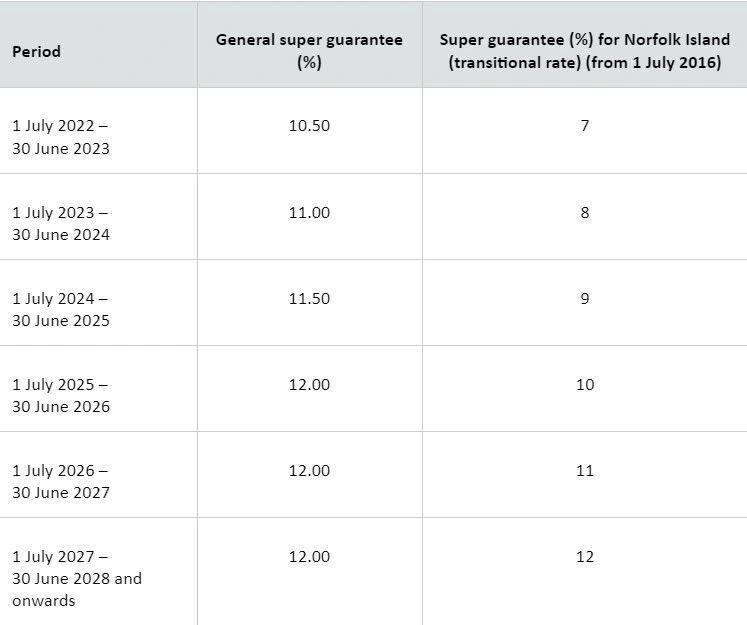
Super guarantee increase

Employers face an increase in their SG liability this year. The rate of SG will increase from 10.5% to 11% from 1 July 2023, before gradually hitting 12% on 1 July 2027 as follows:

Super guarantee percentage


SG is payable on ordinary time earnings (which therefore excludes overtime payments) and may be payable to contractors as well as employees. A liability to a contractor will arise where the contract they work under is wholly or principally for their labour or skills.

The increased rate of 11% will need to be applied to any payments of ordinary time earnings made on and after 1 July 2023, even if some or all of the relevant pay period relates to work performed before 1 July.

Returns are generally healthy 

All things being equal, you can expect a positive return on your super this year.

While returns were minus almost 5% in 2022, negative returns are the exception. There have been only four negative years since 2000 in a period that has spanned September 11, the GFC, and COVID-19.

The average return for the average balanced fund since 2000 is 6.1% – that’s $61,000 a year for every $1 million you can get into super. After double-digit returns in 2017, 2019, and 2021, 6.1% may sound modest, but it is entirely reasonable. In fact, 6-7% is what you can expect over the long term. The period of artificially low rates that inflated annual returns is over, with interest rates now normalised. Estimate your super investment growth using a 6.1% annual return.

A cap to end all caps 

As was announced on 28 February by the current government, a cap on the amount you can have inside superannuation taxed at 15% (not just in a tax-free retirement account) may be imminent. At present, the amount of super on which earnings are taxed at just 15% is unlimited. The government has announced that this 15% rate of tax will be limited to $3 million. Earnings on amounts exceeding that will be taxed at 30% from 1 July 2025, the government has announced. However, even  if this cap finds its way into law,  99.5% of individuals will not be impacted as they hold less than $3 million in their super fund

An extra $200,000 into super this year

Although indexation has adversely contributed to the cost of living, it does have a superannuation upside!

The massive 7.8% inflation rate has triggered what’s called a double indexation in super – and means that the amount of money that can be put into tax-free super is going to turbocharge super contributions…

From July 1, the amount an individual can have in super where the earnings are tax-free in your retirement phase will jump from $1.7 million to $1.9 million. This is a significant change – the tax-free limit has only moved higher once since it was introduced in 2016 (moving by $100,000, from $1.6 million to $1.7 million). The $200,000 increase is a formality unless the government announces an indexation freeze in the upcoming May federal budget.

A Fascinating Behind-The-Scenes Look At An Accountant’s Life

As the end of the fiscal year approaches, Every business scramble to get their books in order and seeks the assistance of accountants to ensure their financial affairs are in order. Accountants are an important part of any business, but their role is frequently misunderstood, and their impact on business success is frequently underestimated. In this blog post, we will look at accountants’ hidden lives and the critical role they play in the Australian business environment.

Accountants are first and foremost in charge of a company’s financial affairs. Everything from bookkeeping and financial planning to tax preparation and financial reporting is covered. Accountants are not just bean counters, as is commonly assumed. They are strategic advisors who assist businesses in growing.

Accountants are trained to understand a company’s financial health and can use this knowledge to advise companies on the best course of action. They can assist businesses in making critical financial decisions such as whether to purchase new equipment, obtain a loan, or expand their operations. They can also provide valuable information about a company’s financial performance and identify areas for improvement.

One of the most important roles accountants play is managing a company’s tax affairs. The Australian tax system is complex, with constantly changing rules and regulations. Accountants are trained to stay on top of these changes and ensure that their clients follow all applicable tax laws. They can assist businesses in lowering their tax burden.

Accountants are also in charge of financial reporting, which is an essential component of all business operations. The preparation of financial statements, such as profit and loss statements, balance sheets, and cash flow statements, is part of financial reporting. These statements provide valuable information about a company’s financial performance and can be used to make important decisions about the company’s future.

Accountants play an important role in helping businesses grow and expand, in addition to these key responsibilities. They can assist companies in raising capital, developing business plans, and identifying new markets and opportunities. They can also provide valuable insights into a company’s financial health and assist companies in making informed decisions about their future.

Despite their importance, accountants often work behind the scenes and their contribution to the success of a business can go unnoticed. However, many businesses would struggle to survive without their expertise and guidance. Accountants are the unsung heroes of business, and their contribution to the Australian economy cannot be overstated.

5 Crushing Myths About Small Business

Small businesses are the backbone of the Australian economy, employing over 6 million people and accounting for over 97% of all businesses. Regardless, there are many myths about small businesses that can lead to misunderstandings and missed opportunities. In this blog, we will read about five of Australia’s most common myths about small businesses.

Myth 1: Small businesses lack professionalism. 

One of the most widely held misconceptions about small businesses is that they are less professional than larger Companies. This is simply not the case. Many small businesses are run by highly skilled professionals with years of industry experience. In fact, because small businesses are frequently owned and operated by their owners, they can provide a more personalized and professional service than larger Companies.

Myth 2: Small businesses cannot compete with larger Companies. 

Another common misconception is that small businesses cannot compete with larger Companies. While small businesses may lack the resources of large Companies, they can still be highly competitive. Small businesses can focus on niche markets, provide more personalized service, and respond to market changes more quickly.

Myth 3: Small businesses always face challenges 

Many people believe that small businesses are always struggling to stay in the market. While small businesses can face financial issues, this is not always the case. In fact, many small businesses are highly profitable and can provide their owners with a high standard of living. Small businesses can thrive with careful planning, hard work, and a little luck.

Myth 4: Small businesses cannot afford to innovate. 

Another widely held misconception is that small businesses cannot afford to innovate. While it is true that innovation can be costly, it is not always necessary to spend a generous sum of money in order to be innovative. Small businesses can be resourceful in identifying low-cost ways to innovate, such as using social media to reach new customers or implementing new technologies to streamline operations.

Myth 5: Small businesses are insignificant. 

Finally, there is a widespread misconception that small businesses are unimportant to the Australian economy. Nothing could be further from the truth. Small businesses are critical to the economy because they create jobs and drive innovation. In fact, many of the world’s largest companies began as small businesses.

Small Business And Tax Savings

Small businesses often struggle with tax savings and it’s not hard to say why. A small business owner has many responsibilities, and it can be difficult to stay up to date with the ever-changing market and changing tax laws. Today in this blog post we will see some harsh truths and ways to deal with them and also give some suggestions.

1. Tax saving takes a lot of time and effort:
The first harsh truth is that it takes a lot of effort for us to avoid taxes. There is no magic formula that will work out our taxes, it just takes a little research and time to save taxes, and to know the deductions and credits available in our business. You have to keep records of all the expenses you are incurring in the business so that you can take advantage of whatever deductions you are getting later.

TIPS: To save tax, you can hire a good accountant, the accountant will identify each of your deductions and credits and help you find the ones you have missed, and ensure that you are taking advantage of all available tax breaks.

2. Not Every Expense Is Deductible:

The Second harsh truth is that not all expenses are tax deductible. While many expenses, such as office supplies and equipment, can be deducted from your taxes, there are many that cannot, such as personal expenses or fines and penalties.

TIPS: Keep track of all your expenses and consult with your accountant or tax professional to ensure that you’re only deducting legal expenses

3. Taxes are required to be paid on time:

The third harsh truth is that taxes must be paid on time. While it may be tempting to postpone paying your taxes in order to improve your cash flow, doing so can result in penalties and interest charges. Furthermore, failing to pay your taxes on time can lead to legal action from the government.

TIPS: Create a budget that includes your tax payments and put the necessary funds aside in a separate account. This will help ensure that you have enough money when it comes time to pay your taxes.

4. Keeping records is critical:

The fourth hard truth is that keeping records is essential. Maintaining accurate records of all business transactions is critical for maximizing tax savings. If you don’t keep track of your income and expenses, you might miss out on tax breaks and credits.

TIPS: Accounting software can help you keep track of all your income and expenses. This will help you stay organized and capture all necessary information for tax purposes.

5. Tax laws are constantly changing:

The fifth harsh truth is that tax laws change regularly. The tax code is constantly changing, and keeping up with all the changes can be hard. What was deductible one year may not be deductible the following year, and new tax credits and deductions may be added at any time.

TIPS: Attend seminars and webinars to stay up to date on the latest tax laws, or work with an accountant or tax professional who specializes in small business tax savings.

6. Tax planning is critical:

The sixth harsh truth is that tax planning is critical. You must plan and make strategic decisions throughout the year to maximize your tax savings. This includes making purchasing decisions, hiring employees, and investing in new equipment.

TIPS: Work with your accountant or tax professional to develop a tax planning strategy that considers your business goals and financial situation.

In conclusion, small business tax savings can be challenging, but by understanding these hard truths and implementing the tips provided, you can minimize your tax bill and keep your business on a path to success. Remember to work with a qualified tax professional and stay up to date with the latest tax laws to ensure that you’re taking advantage of all available tax breaks.

The Simple Formula For Success In Startup In Australia

Starting a business in Australia is an exciting and rewarding endeavour, but it can also be extremely challenging. A clear plan and a solid strategy are required for success in the competitive world of startups. This blog post looks at a simple formula for launching a successful startup in Australia.

Identify the requirements

The first step in creating a successful startup is identifying market needs. Look for gaps in the market and unmet needs that your product or service can fill. Conduct market research to ascertain what potential customers want and require. This enables us to meet these needs and create a market-leading product or service.

Develop a Strong Value Proposition

After identification of needs, you must develop a compelling value proposition. The distinct value that a product or service offers its customers. This value proposition must be clearly communicated to potential customers and investors. Your value proposition should distinguish your product or service from the competition and explain why it is the best choice.

Create a strong team.

Building a dedicated team is critical to the success of a startup. Look for people who have the skills and expertise required to market your product or service. It is critical to find team members who share your vision and are enthusiastic about your product or service. Create a team with diverse skills and experience that can work together.

Concentrate on customer acquisition.

To be successful as a startup, you must prioritize customer acquisition. This entails figuring out how to attract and keep customers for your product or service. Invest in marketing and advertising to increase brand awareness and lead generation. Connect with and engage your customers to increase sales and referrals.

Be open to feedback and changes.

Finally, it is critical to be open to feedback and change. Listen to your customers and investors and be willing to modify your product or service in response to their feedback. Adapt to market changes and be fully prepared to transition if essential. Stay nimble and adaptable to keep your startup competitive and relevant.

To summarize, launching a successful startup in Australia necessitates a well-thought-out plan and a solid strategy. You can increase your chances of success by identifying a need, developing a strong value proposition, building a dedicated team, focusing on customer acquisition, and being open to feedback and adaptation. Best wishes on your startup journey!

Want More Money? Start Investing

Investing in Australia can be a great way to build wealth and secure your financial future. To start investing in Australia, first, understand the economic situation of the country. Australia’s economy is stable and strong, supported by several sectors including mining, agriculture, tourism, and financial services. The government aims to maintain a business-friendly environment that promotes investment, and the country’s high standard of living translates into consumer demand for goods and services.

Once you understand the Australian economy, you can look at the different investment options available. Stocks, real estate, bonds, and mutual funds are among the many investment options available in Australia. With more than 2,000 companies listed on the Australian Stock Exchange (ASX), shares are a popular investment option. Real estate, residential and commercial are other investment options that offer attractive returns.

It is essential to seek professional advice from a financial advisor or investment manager before making any investment decision. They can advise you on the best investment options based on your financial goals, risk tolerance, and investment horizon. They can also help you navigate the regulatory requirements and tax implications of investing in Australia.

Understanding the tax implications of investing in Australia is also critical. The government provides various tax breaks to investors, such as tax deductions for investment-related expenses. However, it is critical to seek professional advice to ensure that you are following all applicable tax laws.

Finally, when first beginning to invest in Australia, start small and diversify your portfolio. Diversification aids in risk reduction and protects your investment portfolio from market volatility. To spread your risk, consider investing in a mix of asset classes such as stocks, real estate, and bonds.

CONCLUSION:  

Before starting an investment, make sure that what is your goal. And how much time do you have to achieve that goal?

Think for yourself how much risk you can take

Organize your finances and do research before investing.

Explore Investment Options In Australia !

If you want to increase your wealth and secure your financial future, investing in Australia can be a good option. In this blog post, we will explore the top investment options available in Australia and how you can start investing today.

Why Choose the Australian Market :

  • Workforce Growth: Australia has a highly skilled and educated workforce, with a strong focus on innovation and entrepreneurship. Due to the population increase, there is a workforce increase which attracts new investors.
  • Capital Expenditure: Capital Expenditure on Infrastructure projects has its own significance in Australia. It includes Transportation, energy, and communication networks. This creates opportunities for businesses in related industries, such as construction and engineering, and supports economic growth by improving productivity and reducing costs
  • Government stability: Australia’s democratic and stable government is committed to maintaining a business-friendly environment. Investors can feel very safe in the country due to its open legal system, minimal levels of corruption, and stable political environment.
  • Australia is a desirable location for investors due to its emphasis on innovation, skilled labour, capital investment, infrastructure development, and stable governance. These elements promote corporate growth and success while providing a safe and encouraging environment for long-term investment.

STOCK 

Investing in the Australian stock market can be a wise financial decision for a variety of reasons. For beginners, the Australian economy is strong and steadily growing, creating a favourable environment for businesses to thrive and, as a result, for investors to profit. Second, investing in the Australian stock market can provide investors with exposure to a diverse range of industries, including finance, mining, and healthcare, which help in portfolio diversification. Third, Australia is home to many high-quality companies with proven track records of growth and profitability, making it an attractive investment destination. Furthermore, many Australian companies pay high dividends, providing investors with a consistent source of income. Investing in the Australian stock market requires opening a brokerage account, funding it, researching, selecting stocks, placing trades, and monitoring your investment.

REAL ESTATE

Investing in real estate in Australia can also be a wise decision for a variety of reasons. For starters, the Australian property market has grown steadily over the years, providing investors with good returns on their investments. Furthermore, the country’s stable and growing economy creates a favourable environment for property investment. Furthermore, Australia’s growing population creates a demand for housing, particularly in major cities. Furthermore, interest rates in Australia are currently at historic lows, making property purchases more affordable for investors. Tax deductions for expenses related to investment properties, such as mortgage interest, repairs, and maintenance, are also available to investors. Finally, investing in real estate allows investors to diversify their portfolios, especially if they are heavily invested in stocks or other asset classes. Investors, on the other hand, should be aware of the risks involved, such as changes in interest rates or property prices, and should always conduct their own due diligence and seek professional advice before making any investment decisions.

Exchange Traded Funds (ETFs)

ETFs are a good choice for investors looking to invest in the wider Australian market. ETFs are collections of shares that track a specific index, such as the ASX 200, which represents the top 200 companies listed on the ASX.

MUTUAL FUNDS 

Investing in mutual funds can be a great strategy to grow your wealth and meet your long-term financial goals. A diversified mix of stocks, bonds, and other securities are purchased through mutual funds, which are professionally managed investment portfolios that pool the cash of numerous investors. When you invest in mutual funds, you have a variety of investment options and can tap into the knowledge of experienced fund managers who constantly assess market conditions and make portfolio changes as needed. Mutual funds also benefit from diversification, which reduces the risk of one investment negatively affecting the entire portfolio. The Australian Securities and Investments Commission (ASIC), which oversees mutual funds in Australia, also provides protection, transparency, and accountability to investors.

The Cash Flow And It’s Budget Fore Casting

Do you find yourself in trouble at the end of the month because of your expenses, petty expenses, or late client payment? It means you are dealing with cash flow issues.

Cash flow is the lifeline of any business whether you are running a small business or running a big firm.

Many companies fall due to poor planning of cash flow management, Let’s thrive on this blog and get a deep understanding of cash flow.

What is Cash Flow?

Cash flow is the flow of cash into and out of a business. This is an important metric for measuring a company’s financial health and is important for businesses of all sizes and types. A cash flow statement is a financial statement that shows a company’s cash inflows and outflows for a specific period. This statement is a crucial tool for entrepreneurs and managers to monitor and manage the company’s financial health.

The three categories of operating activities, investing activities, and financing activities are usually included in a company’s cash flow statement. Operating activities include cash flow in and out of a firm every day, cash from customers, and cash paid to suppliers. Cash inflows and outflows related to investments in assets such as property, plant, and equipment are called investing activities. The term “financing operations” refers to cash inflows and outflows related to financing the company, including dividend payments to shareholders and cash received through loans.

What is budget forecasting in cash flow? 

Cash flow forecasting and budgeting are important parts of a company’s financial strategy. To determine how much money to operate, invest, and finance the business, it is necessary to plan cash inflows and outflows. The purpose of the cash flow forecast is to ensure that the business has enough cash to cover its debts, in addition to being a bonus for investing in business expansion prospects.

Some key features of budget forecasting include: 

Accuracy: A reliable budget forecast should be based on accurate and up-to-date financial data, as well as a thorough understanding of the market and industry trends.

Flexibility: Budget forecasts should be flexible enough to adapt to changing market conditions and unforeseen circumstances.

Collaboration: The budget forecast process often involves collaboration between different departments within an organization, including finance, marketing, and operations.

Regular review: Budget forecasts should be regularly reviewed and updated as necessary to ensure they remain relevant and accurate.

Goal-oriented: Budget forecasts should be aligned with the overall goals and objectives of the business and should help guide decision-making toward achieving those goals.

Budget forecasting is important for businesses for several reasons, including:

Planning for the future: Budget forecasting provides businesses with a roadmap for financial decision-making, allowing them to plan and allocate resources effectively. For example, a retail business might use budget forecasting to plan for seasonal fluctuations in sales and adjust inventory levels accordingly.

Setting financial goals: Budget forecasting helps businesses set financial goals and track progress towards those goals. For example, a startup company might use budget forecasting to set targets for revenue growth and track progress toward achieving those targets.

Managing cash flow: Budget forecasting helps businesses manage cash flow by predicting expected revenue and expenses. For example, a construction company might use budget forecasting to plan for large expenses like equipment purchases or payroll during slow periods.

Identifying potential problems: Budget forecasting can help businesses identify potential financial problems early, allowing them to take corrective action before they become major issues. For example, a healthcare provider might use budget forecasting to identify potential shortfalls in revenue and adjust their billing practices accordingly.

Making informed decisions: Budget forecasting provides businesses with the information they need to make informed decisions about investments, marketing campaigns, hiring, and other important initiatives. For example, a technology company might use budget forecasting to determine whether to invest in research and development or marketing.

Below are the important steps in budgeting and cash flow forecasting:

Reviewing Past Cash Flow: First and foremost, the step is Analyse and review your past cash flow. This analysis helps identify trends and patterns that can help in the future.

Sales Forecasting: Develop a sales plan, as sales are the main source of cash flow. By forecasting sales, businesses can determine how much money they will make.

Calculate Costs: You also need to determine how much it costs to run the business. This includes all costs such as the cost of goods sold and overhead expenses like rent and utilities

Make a statement of cash flows: After completing the above steps a company can create a cash flow statement that estimates future cash inflows and outflows

Planning for alternative scenarios: After developing a baseline forecast a company should run different scenarios to assess the impact of various changes. for instance, if sales are higher or lower than expected. What if expenses go up or down? Such kind of scenario can arise; we should make proper arrangements to cope with changes.

Monitor and adjust: Cash flow forecasting is not one-time planning; it is a continuous process. A business must compare actual cash flow to expected cash flow and make any adjustments whenever needed

Pros of budget forecasting:

Improved financial planning: Budget forecasting helps businesses plan and allocate resources more effectively, leading to better financial management.

Better decision-making: With a clear understanding of expected revenue and expenses, businesses can make informed decisions about investments, marketing campaigns, hiring, and other important initiatives.

Increased accountability: Budget forecasts hold businesses accountable for meeting financial goals and help track progress towards those goals.

Early identification of potential problems: By forecasting revenue and expenses, businesses can identify potential financial problems early and take corrective action before they become major issues.

Increased efficiency: Budget forecasting can help businesses streamline their operations and reduce waste, leading to increased efficiency and cost savings.

Cons of budget forecasting:

  • Inaccuracy: Budget forecasts are based on assumptions about future revenue and expenses and may not always be accurate. Unexpected changes in market conditions or other factors can lead to significant deviations from the forecast.
  • Time-consuming: Preparing a budget forecast can be a time-consuming process, requiring significant resources and attention to detail.
  • Unrealistic expectations: Budget forecasts may set unrealistic expectations for revenue growth or expense reduction, leading to disappointment or frustration if these goals are not met.
  • Lack of flexibility: Budget forecasts may be too rigid and not allow for adjustments to changing market conditions or unexpected events.
  • Overreliance on data: Budget forecasts may place too much emphasis on historical financial data and not consider other factors that may impact future revenue and expenses, such as changes in consumer behaviour or new market entrants.

Overall cash flow is an important metric for measuring a company’s financial health. Budgeting and cash flow forecasting are important for any business. Analyzing past cash flows, making sales forecasts, estimating costs, and taking necessary decisions.

Exploring Small Business Financing Options

Small business financing refers to the process of obtaining capital or funding to start or grow a small business. Small business financing can take many forms, including loans, lines of credit, down payments, grants, invoice financing, equipment financing, and more. Small business financing is essential for small business owners to purchase inventory, invest in growth initiatives, and meet short-term cash flow needs. There are lots of options available for raising funds for your business

Bank Loans

Bank loans are a popular financing option for small businesses. They offer competitive interest rates and fixed payment terms. However, it requires collateral and a good credit score. Also, the application process can be time-consuming and difficult. It has pros and cons too.

Let’s check some of its advantages

  • Low-interest rates: Bank loans usually offer lower interest rates than other financing options, such as credit cards or alternative lenders. This can help small businesses save money on interest payments over time.
  • Fixed payment terms: Bank loans usually use fixed payment terms, which means that monthly payments remain fixed for the duration of the loan. This can help small businesses create budgets and plan their finances accordingly.
  • Collateral requirements: Bank loans often require collateral, which can be valuable assets such as real estate or equipment. This can help small businesses get larger loan amounts or better interest rates.
  • Established Relationships: Small businesses that have long-standing relationships with banks can negotiate better loan terms, such as lower interest rates or reduced payments.

However, bank loans also have some disadvantages:

  • Reliable application process: Bank loans usually require extensive documentation and a thorough assessment of the business’s financial health and creditworthiness. This can be time-consuming and require considerable effort on the part of the business owner.
  • High credit score requirement: Bank loans often require a high credit score. Small businesses with poor or limited credit history can find it difficult to get a bank loan.
  • Limited flexibility: Bank loans usually use fixed payment terms and a fixed loan amount. This may not work for smaller businesses that need more flexibility in their financing options.
  • Fixed risk: Bank loans require regular payments and failure to meet these payments can lead to default. It can damage a business’s credit score and financial health.

Crowdfunding: 

Crowdfunding is a popular funding method for small businesses in Australia. It involves raising funds through an online platform from a large number of people who donate small amounts of money.

Some of the advantages of crowdfunding in Australia include:

  • Access to capital: A down payment can give small businesses access to capital quickly without collateral or a good credit history.
  • Customer Validation: Paying big bucks can help small businesses test their products or services with potential customers, validate demand, and refine their marketing strategy.
  • Community Building: Crowdfunding can help small businesses build a supportive community that invests in their success and can provide feedback, marketing support, and referrals.
  • Exposure: Paying more can help small businesses gain more media attention by helping them build brand awareness

Some of the disadvantages of crowdfunding in Australia include:

  • Fees: Many crowdfunding platforms charge a fee of 5-10% of the total funds collected, which can significantly reduce the number of funds collected.
  • Time-consuming: Most fundraising campaigns require a significant amount of time and effort to plan and execute, including creating an attractive campaign page, marketing and promoting the campaign and arranging rewards for backers.
  • Risk of Failure: There is no guarantee of success with most fundraising campaigns, and if the campaign does not meet its fundraising goals, the business will not receive the amount of funding it needs.
  • Investor expectations: Investors who have made a lot of money can expect a return on their investment, which can put pressure on small businesses to deliver results.

However, this is a competitive process and success is not guaranteed

Government grants

Government grants are a popular form of funding for small businesses in Australia. Typically, federal, state, or local governments help businesses finance specific projects or initiatives.

 Some of the advantages of government grants in Australia are:

  • Non-repayable: Government grants do not need to be repaid, so they can provide a large amount of capital for small businesses without incurring the burden of debt.
  • Focused funding: Government grants are usually offered for specific projects or initiatives that can help small projects finance specific needs, such as research and development, export, or sustainability projects.
  • No capital required: Government grants do not require small businesses to give up equity in exchange for financing, which can be an advantage for businesses that want to control their operations.
  • Improve credibility: Receiving government grants can improve the image and reputation of a small business in the market, which can help attract new customers and investors.

And some of its Disadvantages:

  • Competition: Government grants are highly competitive and often have a limited amount of funding. Small businesses may have to compete with other businesses for grants, which can make things difficult.
  • Complicated application process: The application process for government grants can be complex and time-consuming, requiring detailed documentation and reporting on the use of funds.
  • Limited Use: Government grants are usually offered for specific projects or initiatives that may limit their flexibility and applicability to small businesses.
  • Reporting requirements: Government grants often come with reporting requirements, including regular financial and performance reports, which can be burdensome for small businesses.
  • Government grants can be a valuable financing option for small businesses in Australia, but they require careful consideration and planning.

Invoice financing

Invoice financing is a type of financing where a business sells an outstanding invoice to a third-party company and advances a percentage of the invoice value in lieu of payment.

Let’s check some of its advantages

  • Quick access to cash: Invoice financing provides small businesses with quick access to cash, allowing them to meet short-term cash flow without waiting for their customers to pay their invoices.
  • No Collateral Required: Invoice financing is based on invoice value, so small businesses don’t need to provide collateral or have a strong credit history to qualify.
  • Increase Cash Flow: Invoice financing can increase cash flow for small businesses by providing regular cash to cover operating expenses and invest in growth initiatives.
  • What: Invoice financing is a flexible financing option that suits the needs of small businesses, with the option to finance all or part of their invoices.

It also comprises of disadvantage

  • Higher fees: Invoice financing can be more expensive than traditional financing options, with fees ranging from 1-5% of the invoice value and higher interest rates than conventional loans.
  • Customer Relationships: Invoice financing involves third-party companies contacting business customers to collect payments, which can complicate customer relationships if not handled carefully.
  • Customer Reliance: Invoice financing depends on customers paying invoices on time. If the customer refuses to pay, the business may be liable for advance and related costs.
  • Limited availability: Invoice financing may not be available to all small businesses as it requires a minimum monthly invoice and invoices must be issued to trusted customers.

Vehicle or equipment 

Vehicle or equipment finance is a common financing option for small businesses in Australia.

Let’s check some of its advantages

  • Ease of financing: Car or equipment financing is easier than other types of financing because the vehicle or equipment serves as collateral for the loan.
  • Low-interest rates: Since the loan is secured by the vehicle or equipment, the interest rate for vehicle or equipment financing is lower than an unsecured loan.
  • Fixed payment terms: Vehicle or equipment financing usually has fixed payment terms, which can help small businesses budget for costs and plan for cash flow.
  • Tax Deductions: Small businesses can claim tax deductions on interest paid on vehicle or equipment financing.

Disadvantages:

  • Asset Depreciation: Vehicles and equipment can depreciate quickly, meaning the value of the collateral used to secure a loan can decrease over time, leaving small businesses with more debt than the value of the collateral.
  • Limited Use: Vehicle or equipment financing is only suitable for businesses that require the operation of the vehicle or equipment. It may not be suitable for businesses that require financing for other expenses.
  • Payment obligations: Small businesses that finance vehicles or equipment have payment obligations that can put a heavy burden on cash flow if they are unable to meet their payment obligations.
  • Potential foreclosure: If a small business defaults on a loan, the lender may repossess the vehicle or equipment used to secure the loan, which may have negative consequences for the business.
  • Overall, vehicle or equipment financing can be a suitable financing option for small businesses in Australia that require vehicles or equipment to operate.

In summary, small businesses have several financing options to choose from, each with its own advantages and disadvantages. Before choosing the most suitable financing option, it is very important to assess the needs, goals, and financial situation of the business.

Please note that this blog does not provide financial advice. After discussing various financing options for your business, choosing the right one can be confusing. We encourage you to educate yourself and do more research on the topics we discuss. However, it is recommended that you seek advice from a trusted financial advisor who can help you make an informed decision based on your personal circumstances.

ATO Practical Compliance Guideline: FBT Exemption For E Vehicle

The Australian Taxation Office (ATO) has recently issued PCG 2023/D1, a revised practical compliance guideline for exemption from paying Fringe Benefits Tax (FBT) on eligible electric cars.

Starting from July 1, 2022, employers in Australia will be exempt from paying Fringe Benefits Tax (FBT) on eligible electric cars and associated car expenses, but only if certain conditions are met.

Firstly, the car must be classified as a zero or low-emissions vehicle, which includes battery electric vehicles, hydrogen fuel cell electric vehicles, or plug-in hybrid electric vehicles. However, it’s important to note that starting from April 1, 2025, plug-in hybrid electric vehicles will no longer be considered zero or low emissions vehicles under FBT law, unless they were exempt before that date and there is a binding commitment to continue providing private use of the vehicle.

Furthermore, the FBT exemption only applies to vehicles that are classified as “cars” for FBT purposes, which means they must be designed to carry a load of less than one tonne and accommodate fewer than 9 passengers. Other types of electric vehicles, such as electric motorcycles and scooters, will not qualify for this exemption.

Another condition for the FBT exemption is that the car must be held and used for the first time on or after July 1, 2022. The car can be owned or leased prior to this date, but it must not be used until after July 1, 2022. The term “held” in this context refers to ownership, leasing, or availability by another entity.

Additionally, the car must be used by a current employee or their associates, including family members, to be eligible for the FBT exemption. It’s also important to note that no luxury car tax should have been payable on the supply or importation of the car. This means that the value of the car at the first retail sale must be below the luxury car tax threshold for fuel-efficient vehicles, which is $84,916 for the 2022-23 financial year.

If all these conditions are met, the FBT exemption will also cover associated car expenses for the vehicle, such as registration, insurance, repairs or maintenance, and fuel costs, which include the cost of electricity to charge and run the vehicle. The Australian Taxation Office (ATO) is currently working on a draft practical compliance guideline (Draft PCG) that will provide a methodology for determining the approximate cost of electricity when charging a zero or low-emissions vehicle at an employee’s or an individual’s home.

It’s worth mentioning that a home charging station is not considered a car expense associated with providing a car fringe benefit for electric cars. However, depending on how an employer sets up a charging station for their employee, it may be considered a property fringe benefit or an expense payment fringe benefit.

Exempt Electric Cars: Understanding Reportable Fringe Benefits

Starting from 1st July 2022, employers are no longer required to pay Fringe Benefits Tax (FBT) on eligible electric cars and associated car expenses, given that certain conditions are met. However, it’s important to note that while the private use of these exempt electric cars is not subject to FBT, the value of the benefit must still be included when calculating whether an employee has a reportable fringe benefits amount (RFBA).

Employers need to determine the notional taxable value of the benefits associated with the private use of the exempt electric car. An employee will have an RFBA if the total taxable value of certain fringe benefits provided to them or their associate exceeds $2,000 in an FBT year. The RFBA must be reported through Single Touch Payroll or on the employee’s payment summary.

There are some further considerations to keep in mind regarding the exemption for electric cars:

  1. Hybrid vehicles that are not plug-in hybrid electric vehicles are not covered by the exemption. Only battery electric vehicles, hydrogen fuel cell electric vehicles, and plug-in hybrid electric vehicles meet the criteria for zero or low-emissions vehicles.
  2. The cost of home charging equipment for electric vehicles and whether it can be capitalized into a novated lease without affecting the nature of the lease is a relevant issue to consider.
  3. Registration and state or territory road user charges are also important factors to take into account. The Australian Taxation Office (ATO) has released a fact sheet on electric vehicles and fringe benefits tax that addresses these practical issues.
  4. Provided that the eligibility conditions mentioned above are met, the exemption also applies to second-hand electric cars. However, practical issues may arise in proving when the car was first used and whether the luxury car tax was paid, as vendors may not be obligated to provide such information.
  5. It’s also important to consider the impact of various state-based rebate programs on leases, as these programs may affect the overall tax implications of using electric cars for business purposes.

In conclusion, the exemption from FBT on eligible electric cars and associated car expenses is a significant development for employers and employees alike. However, it’s crucial to understand the reporting requirements and consider other relevant factors when taking advantage of this exemption. Consulting with a tax professional or referring to the ATO’s guidelines can provide further clarity and ensure compliance with the tax laws.

Small Business Parking Exemption: Understanding FBT Benefits

Small businesses can enjoy an exemption from Fringe Benefits Tax (FBT) on car parking benefits, given that certain conditions are met. This exemption applies if the parking is not provided in a commercial car park, if the business’s gross total income for the last income year ending before the start of the relevant FBT year was less than $10 million, or if the aggregated turnover was less than $50 million.

The FBT is a tax that employers may be required to pay on certain benefits provided to their employees, including car parking benefits. However, small businesses meeting the eligibility criteria mentioned above can be exempt from this tax, providing a significant benefit to their operations and bottom line.

One of the key conditions for the small business parking exemption is that the parking must not be provided in a commercial car park. A commercial car park is defined as a car park that is open to the public and charges a fee for parking, or a car park used by the public that is located within 1 kilometre of a commercial car park that charges a fee for parking. If the parking provided by the small business does not meet this definition, it can be eligible for the exemption.

Additionally, the small business must meet the income requirements for the last income year ending before the start of the relevant FBT year. If the gross total income of the business was less than $10 million, or the aggregated turnover was less than $50 million, the business can qualify for the exemption. It’s important to note that aggregated turnover includes the annual turnovers of the business and its connected entities, which can affect the eligibility for the exemption.

It’s crucial for small businesses to understand the requirements and conditions for the FBT small business parking exemption, as failing to comply with the tax laws can result in penalties and fines. Keeping accurate records and seeking professional advice from a tax expert can ensure that small businesses take advantage of this exemption properly and avoid any potential compliance issues.

In conclusion, the small business parking exemption provides a valuable benefit to eligible businesses by exempting them from paying FBT on car parking benefits. Meeting the conditions of not providing parking in a commercial car park and meeting the income requirements can result in significant tax savings for small businesses. It’s essential to understand the eligibility criteria and comply with the tax laws to fully utilize this exemption and reduce the tax burden on small business operations.

Demystifying The Basics of Balance Sheet : A Guide For Businesses

If you are a business owner in Australia, understanding financial reporting is essential to managing your operations effectively. The main financial statement that provides an overview of the financial health of your business is the balance sheet. In this blog post, we’ll break down the basics of the balance sheet, explain its importance, and outline the key elements that businesses in Australia need to know.

What is a Balance Sheet? 

A balance sheet is a financial statement that provides a snapshot of a business’s financial position at a specific point in time. It is called a balance sheet because it must always balance, with assets equalling liabilities plus owner’s equity. In simple terms, a balance sheet shows what a business owns (assets), what it owes (liabilities), and what is left for the owners (equity).

Importance of a Balance Sheet 

A balance sheet is an important tool for assessing the financial health of a business and its ability to meet short-term and long-term obligations. It provides insight into the liquidity, solvency, and financial stability of the entire business, which is an important factor for investors, lenders, and other stakeholders. In addition, balance sheets are required for businesses to comply with financial reporting standards and tax regulations in Australia.

Key Components of a Balance Sheet 

Assets: Assets are what a business owns and can include cash, liabilities, inventory, property, plant and equipment, and investments. Assets are current assets (expected to be converted into cash or used within 12 months) and non-current assets (expected to provide economic benefits after 12 months).

Liabilities: Liabilities are the debts of the business and can include debts, loans, and other debts. Liabilities are classified into current liabilities (estimated to be settled in 12 months) and non-current liabilities (estimated to be settled after 12 months).

Owner’s Equity: Owner’s Equity refers to the remaining interest in the assets of the business after deducting the liabilities. This includes the owner’s initial investment, retained earnings (reinvested income), and other investments.

Understanding the balance sheet equation: Assets = Liabilities + Owner’s Equity

As mentioned earlier, the balance equation must always be balanced. This means that the business must be equal to the total amount of assets, liabilities, and owner’s equity. This equation illustrates the basic concept of double-entry bookkeeping, which ensures that each transaction balances on both sides of the balance sheet.

Interpreting a Balance Sheet

Analysing a balance sheet can provide valuable insights into a business’s financial health. Here are some key ratios and metrics that businesses in Australia can use to interpret their balance sheet:

Current Ratio: This ratio measures a business’s short-term liquidity, calculated as current assets divided by current liabilities. A ratio above 1 indicates that a business has enough assets to cover its short-term liabilities.

Debt-to-Equity Ratio: This ratio measures a business’s leverage and risk, calculated as total liabilities divided by owner’s equity. A higher ratio indicates that a business relies more on debt financing, which may increase its risk.

Return on Equity (ROE): This ratio measures a business’s profitability, calculated as net income divided by owner’s equity. A higher ROE indicates that a business is generating higher returns for its owners.

Why Balance Sheets are Important for Every Business

A balance sheet is a key financial statement that is important to businesses and stakeholders. Some of the main reasons why balance is important are:

Financial snapshot: the balance sheet provides a snapshot of the financial position of the business at a certain point in time. It summarizes assets (assets), liabilities (liabilities), and shareholders’ equity (equity). This information is important to assess the financial health and stability of the business.

Financial Management: The balance sheet helps businesses manage their finances effectively. By tracking and analyzing the assets, liabilities, and owner’s equity, businesses can make informed decisions about managing their resources, such as cash flow, inventory levels, and debt obligations. It also helps in evaluating the need for additional financing and capital investment.

Stakeholder Assessment: The balance sheet is the primary financial statement that stakeholders such as investors, creditors, and potential partners rely on to assess the financial strength and sustainability of the business. It provides insight into a company’s ability to meet its financial obligations, manage risk and generate revenue. A healthy balance sheet can boost confidence in stakeholders and attract investment and financing opportunities.

Financial Reporting: The balance sheet is an essential component of a business’s financial reporting process. It is required by accounting standards and regulations to be included in financial statements, along with other financial information. It provides transparency and accountability in a business’s financial reporting, allowing stakeholders to assess its financial performance and position accurately.

Business Valuation: A balance sheet is a critical tool in determining the value of a business. It provides information about the company’s assets, liabilities, and owner’s equity, which is crucial in assessing its worth. Investors, potential buyers, and other stakeholders often rely on the balance sheet to evaluate the value of a business for investment, acquisition, or other purposes.

Financial Decision-Making: The balance sheet serves as a foundation for making informed financial decisions. It helps businesses in determining their liquidity position, solvency, and equity position, which are crucial factors in making strategic decisions related to capital allocation, investment opportunities, and risk management.

Example of Balance sheet

Example of a simplified balance sheet for a fictional company XYZ Corporation as of December 31, 2022: 

XYZ Corporation

Balance Sheet

As of December 31, 2022

Assets: 

Current Assets: 

Cash and Cash Equivalents: $100,000

Accounts Receivable: $150,000

Inventory: $200,000

Total Current Assets: $450,000

Property, Plant, and Equipment: $800,000

Less: Accumulated Depreciation: ($200,000)

Net Property, Plant, and Equipment: $600,000

Intangible Assets: $250,000

Total Assets: $1,300,000

Liabilities: 

Current Liabilities: 

Accounts Payable: $100,000

Short-term Borrowings: $50,000

Total Current Liabilities: $150,000

Long-term Liabilities: 

Notes Payable: $300,000

Bonds Payable: $200,000

Total Long-term Liabilities: $500,000

Total Liabilities: $650,000

Stockholders’ Equity: 

Common Stock: $500,000

Retained Earnings: $150,000

Total Stockholders’ Equity: $650,000

Total Liabilities and Stockholders’ Equity: $1,300,000

In this example, the balance sheet shows the company’s assets, including current assets (such as cash, accounts receivable, and inventory), property, plant, equipment, and intangible assets. It also lists the company’s liabilities, including current liabilities (such as accounts payable and short-term borrowings) and long-term liabilities (such as notes payable and bonds payable). Lastly, it shows the stockholders’ equity, which includes common stock and retained earnings. The balance sheet equation “Assets = Liabilities + Stockholders’ Equity” is balanced, indicating that the company’s total assets are equal to its total liabilities and stockholders’ equity.

Let’s look at the Limitation

Just like any other financial statement, the balance sheet also has certain limitations that need to be considered. Let’s explore these limitations below:

Historical Snapshot: The balance sheet provides a snapshot of a business’s financial position at a specific point in time. However, it does not capture changes in financial position or performance over time. It reflects historical information and may not always provide a real-time or forward-looking view of a business’s financial health.

Valuation of Assets: The balance sheet presents assets at their historical cost, which may not reflect their current market value. For example, land or buildings purchased many years ago may be carried on the balance sheet at their original cost, which may not represent their current fair market value. This can impact the accuracy of a business’s financial position and may not fully reflect the true value of its assets.

Intangible Assets: The balance sheet may not fully capture the value of intangible assets, such as brand value, customer relationships, or intellectual property, which can be significant contributors to a business’s overall value. Intangible assets are often not reported on the balance sheet unless they are acquired through a business combination, which can result in an incomplete picture of a business’s total assets.

Depreciation and Amortization: The balance sheet reflects assets net of accumulated depreciation and amortization, which are accounting methods used to allocate the cost of long-term assets over their useful lives. However, the depreciation and amortization methods used may not accurately reflect the actual decrease in the value of these assets over time, leading to potential inaccuracies in the balance sheet values.

Liabilities and Contingent Liabilities: The balance sheet may not fully capture all liabilities and contingent liabilities of a business. Liabilities may not be recognized if they are not known or reasonably estimable, and contingent liabilities, such as potential legal claims or warranty obligations, may not be fully disclosed. This can result in an incomplete picture of a business’s true liabilities and financial obligations.

Changes in Accounting Policies: The balance sheet may not be directly comparable between different periods or different companies due to changes in accounting policies. Accounting standards and policies can change over time, and businesses may adopt different accounting methods, making it challenging to compare balance sheets from different periods or companies.

Losses and Errors: Balance sheets depend on the accuracy and completeness of financial data and information. Errors or omissions in recording contracts, appraisals, or valuations can affect the accuracy of the balance sheet, which can lead to misrepresentation of the financial position of our business.

Conclusion

A balance sheet is an important financial statement that provides insight into the financial health and sustainability of a business. Understanding the components and their key relationships can help Australian businesses assess their liquidity, solvency, and profitability and make informed decisions. It is important to keep accurate and up-to-date records of financial transactions in order to prepare an accurate balance sheet